As previously mentioned, 2022 was a strange year for me. On top of everything else going on, I had all this academic energy that wasn’t really going anywhere. Additionally, at no other time in my life have I been as committed to the bit. All this to say that I got really into Elvis. I have spent quite a bit of time thinking about why Elvis would be my hyper fixation of choice —Was it because the movie1 was coming out and I love Austin Butler? Was it because Sophia Coppola (one of my favorite directors) was going to make a reactionary Pricilla2 movie? Was it because he is just so quintessentially American? Is it because I knew there was enough lore to keep me occupied? Whose to say. I did know that I was attracted to the arc of his life; there was something gothic and distinctly southern about his story—the fame, talent, uncharted heights of stardom, a career that was all fits and starts, and in the end, dead on a toilet at 42 years old. Here are some of my favorite tidbits or foundational ideas that I came across during the course of 3 books, 4 documentaries, 2 fictional adaptations, a trip to Graceland, Memphis, and Tupelo, Missouri.
Rock and Roll Generally
It is hard to imagine a world without rock and roll because it has so totally melded into and been discarded by modern music. Rock and roll, in its most basic form, is country music mixed with rhythm and blues. It became clear as I learned about the time period that to understand why and how Elvis sang was such a big deal, the racial politics of music was crucial. It was as segregated as everything else: white people listened to classical music, hillbilly/ country, gospel music, and white people jazz (jazz without swing– it’s not good). Black people listened to rhythm and blues, jazz, and their own (better) version of gospel music. Race mixing didn’t just refer to the white racist panic about babies, it was understood as anything that mixed the two different cultures. Rock and Roll had always had sexual connotations (I mean, it’s called rock and roll for heaven’s sake), and it mixed this swing from black R&B with white country music, essentially mating the two races. Whites and Blacks moved differently on stage—white people, for example, didn’t. Sure, they might walk and forth a little bit, maybe bounce a bit to the beat but barely (it’s pretty weird to watch today after 100 years of people moving around when they sing). Black people on the other hand moved around in a way that is considered normal now in a performance—they danced, they swung with the rhythm, they felt it in their bodies. They were also more likely to make obvious the sexual undertone of their songs in their movement—again, something that is normal now. So, Elvis, with his “gyrating hips” and slutty little smirk, plus the form of the music being this mixture of the two races, was, to racist white evangelicals, very threatening, too sexy.
The Rise
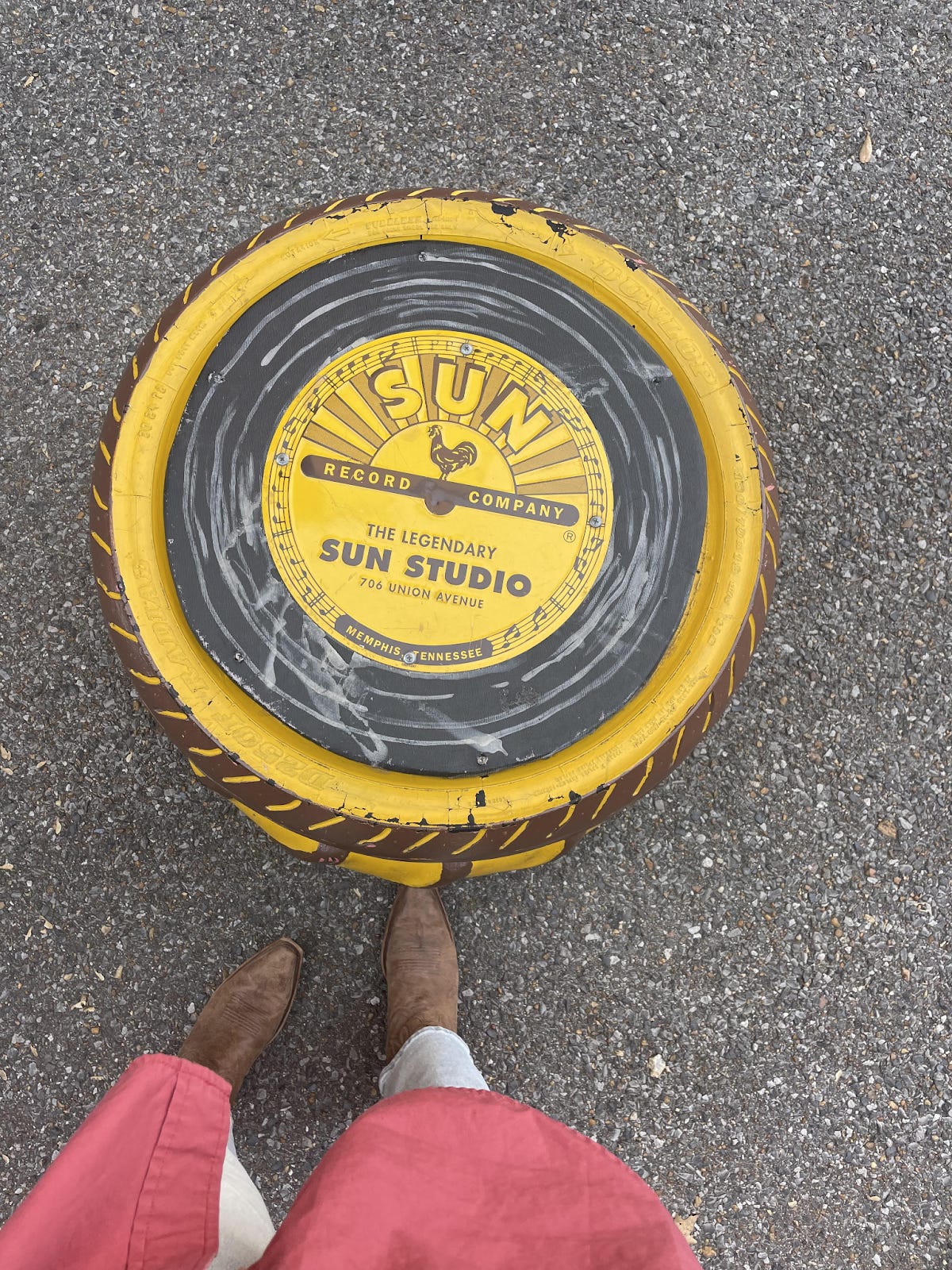
Elvis, in a lot of ways, was just in the right place at the right time. The first “rock and roll” song was Rocket 88, recorded in 1954 by Jackie Brenston and Ike Turner at Sam Phillip’s recording studio, Sun Studios, in Memphis. Sam was an interesting man—he wanted more opportunities for black musicians to record their music ideologically but also because he thought there was a market for it and that if there was the right situation, he could get really rich. Sam was actively looking for someone to popularize black music with white audiences “Over and over I remember Sam saying, ‘If I could find a white man who had the Negro sound and the Negro feel, I could make a billion dollars’” Marion Keisker, his secretary remembered. Elvis goes into Sam’s studio one day and records a couple of songs, but nothing happens. Time passes and one day they need a studio singer for a song they are working on, so they call Elvis up and it does not go well. The night drags on and they are taking a break, about to give up, when Elvis starts messing around with the guitar, dancing, and playing “That’s All Right.” The band joins in, they lay it down, and the next day they take it to the radio station, and it blows up.
As we all know, screaming teenage girls control the music industry. There is a feral fanaticism to teenage fandom that is simply unparalleled in any other demographic. Did Sam Phillips know this? I doubt it. But the reality is that, before Elvis, teens were a mostly untapped market as far as spending power and products marketed specifically for them. This was the first time that music was for teenagers. Teen boys wanted to dress like him, and teen girls wanted to date him (or more lol repressed teenage female sexuality is a profitable demographic). All of the sexual innuendos were not lost on the girlies, and they threw money and fame at him all the way until they were all grown up and he was dead.
Did Elvis Steal His Songs? Yes ❤
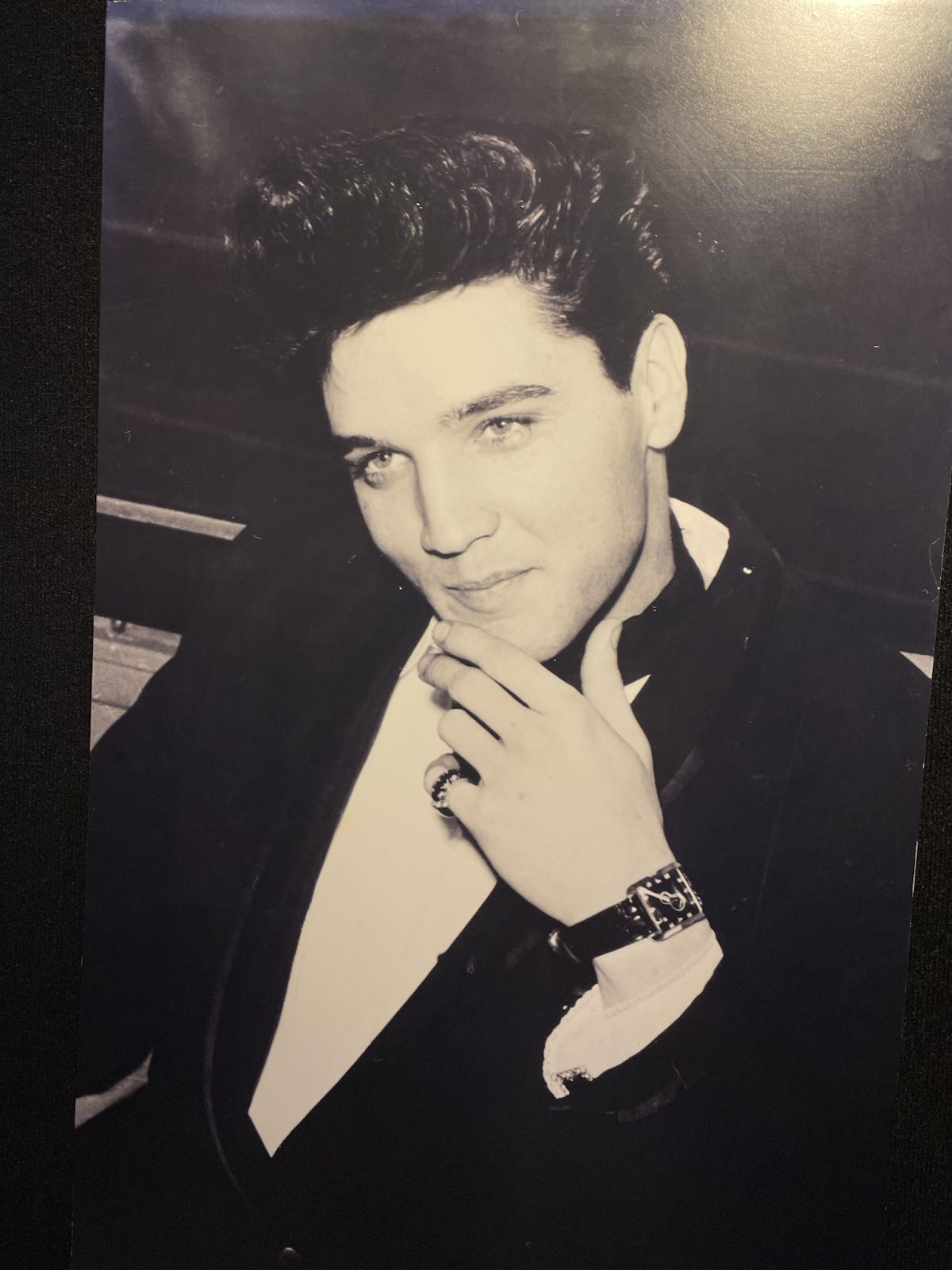
Elvis never wrote his own songs; he never had any interest in doing so. Lots of people have accused Elvis of stealing the songs of black artists and that is absolutely correct. He copied the songs, the way they sang them, and the movements they used. He kind of knew it too; once at a press conference he saw Fats Domino and pulled him to the front of the room to say that Fats was the real King of Rock and Roll, which was almost certainly truer than Elvis being the originator. What did black people think about Elvis? Well, obviously, it varies. Ray Charles was not a fan.
In 1994, Ray Charles sat down for an interview with NBC’s Bob Costas and gave a scathing critique of Elvis Presley. ‘To say that Elvis was so great and so outstanding like he’s the king…the king of what?’ Charles said. ‘I know too many artists that are far greater’—singers like Nat King Cole, who got assaulted by white audiences for performing rock music, while Elvis received widespread acclaim. ‘He was doing our kind of music,’ Charles said. ‘So what the hell am I supposed to get so excited about?’3
Elvis was singing the type of music that black artists had been singing longer and better but were not accepted because of racism and Elvis made money off that discrepancy. However, others defended him like long-time friend BB King. King said that Elvis
had everything. The looks, the talent… Music is owned by the whole universe… It isn’t exclusive to the Black man or the white man or any other color. Elvis didn’t steal any music from anyone. He just had his own interpretation of the music he’d grown up on, same is true for everyone.
Little Richard, Sister Rosetta Thorpe, and Big Mama Thornton all had negative perceptions of Elvis having originally recorded songs that Elvis heard, liked, recorded, and made lots of money off of, while they got little to nothing financially. Some argue that Elvis popularized the genre in a way that opened the doors for black musicians down the road.
Not owning your songs is unfamiliar in a world where songwriting is as legendary as performing and artists fight to have ownership of their songs. The concept of “owning a song” has changed quite a bit in the last 100 years. In the same way that jazz standards are repeated over and over again, everybody was singing other people’s music. Elvis was merely putting his spin on a song, songs written by blacks and whites. And he was good at it! As much as this sucked for black artists, it also ended up being bad for Elvis too. It meant that he didn’t have as much creative control and was often at the mercy of the record company and his manager. He sang a lot of covers and they are very good but now it would be odd to have the biggest star in the world have a whole career singing different versions of old songs.
Elvis’s Family
Elvis had zero normal relationships from all accounts and was startlingly immature.
Freud has struck once again. He and his mother had a loving (too loving?) relationship, but she was also intense and domineering. He only trusted her completely and she micromanaged a lot of things in his life. She treated him like a child, and they spoke baby talk to each other well into his adult life. He never really recovered after she died. His weird relationship with his mother affected all his romantic relationships in strange and salacious ways. It was never violent or disturbing—mostly just really sad and strange.
His father “managed” Elvis’s money and he was not good at it. Early in Elvis’s life, his dad went to jail for writing a bad check when he was little, and this left the family in constant fear that he would go back, which was not particularly rational, but they certainly had respect for rock bottom. He had a real scarcity mindset, even at the height of his fame and this constant fear of poverty made him take easy cash (like all of those terrible movies he did in the 60’s).
His wife was a child! Criminal, pedophile, etc. Go watch the Pricilla movie or even better, read Elvis and Me, Pricilla’s memoir. It reads like a People magazine article and treads the line of love and grooming in a fascinating way. She reveals more than I think she meant to.
Middle Period
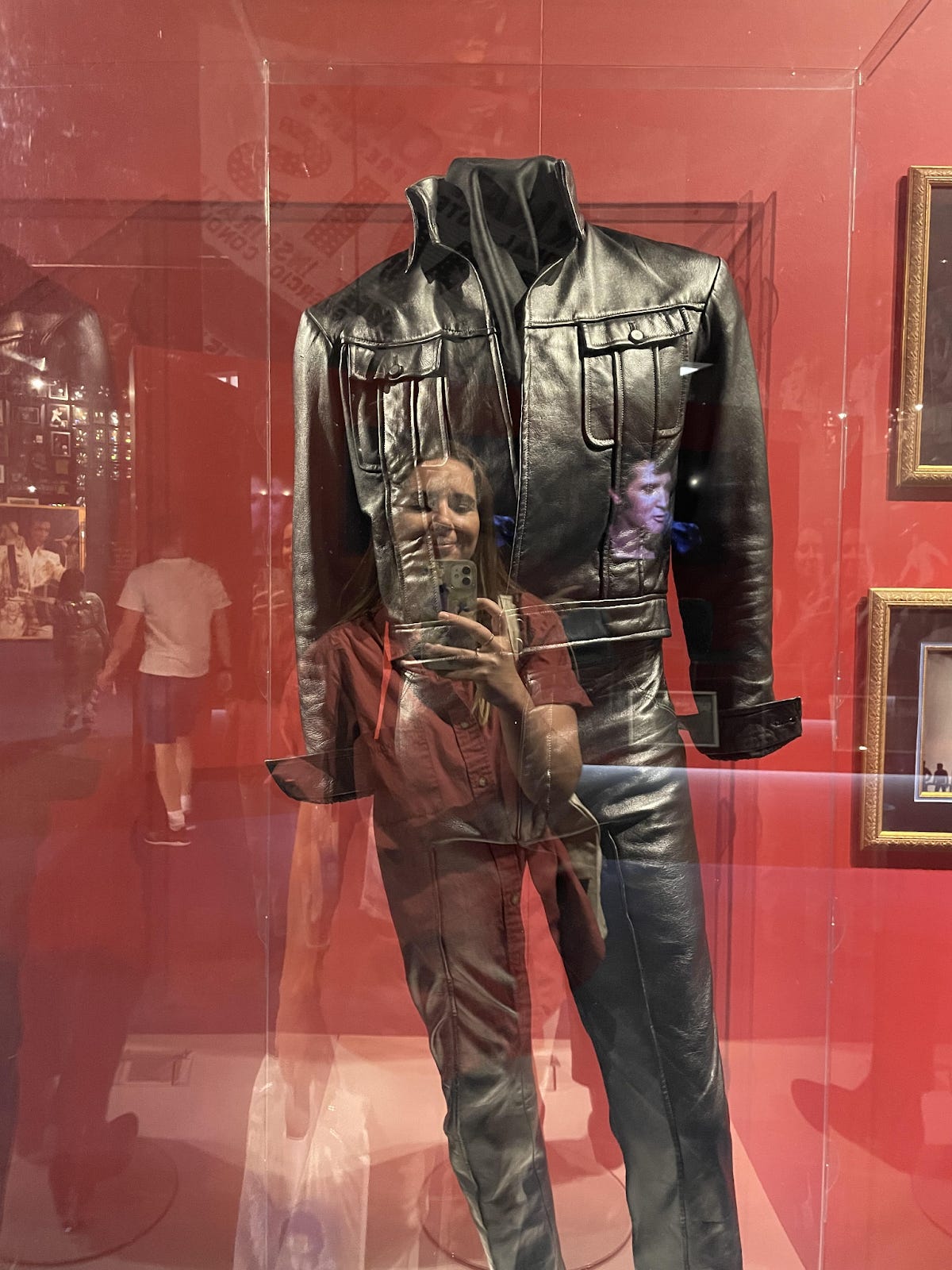
In the middle period of his career, he served in the army, did a decade’s worth of bad movies,4 did the 68’ special which revitalized his career, and then tours until the end. He was fantastic on stage which I think is worth mentioning, it is truly incredible, the man had PRESENCE. Elvis on Tour is on HBO and it’s a great capture of how famous he was and what he was like. During this time, a critic said that once Elvis covered a song, it was done, that was the best version of the song. He was always pushing his voice—he loved Italian arias and wanted to sing them well. He continued to love and record gospel music—every time he was coming back to himself creatively, he cut a gospel record. The music got better and then, slowly got worse.
The Downfall
One of the things that stands out over and over again in his life is just how uncharted his trajectory was—aging superstardom, drugs, boundaries, messy romantic relationships—these were things that no one had really seen in such a public person and musical artist. In my opinion, there were three things that led to his downfall. The first is that he was not surrounded by people that knew how to support him. His entourage was a group of guys from his adolescence who were basically just yes men. They hung out with him, they hyped him up, they found girls for him (Pricilla was spotted by one of his friends that thought Elvis would like her– yikes), they were at his beck and call and in return they spent his money lavishly. Everyone that wasn’t in the little gang thought they were annoying, but Elvis kept them around, it seemed, because they would do anything for him. Sadly, because he was only surrounded by people whose lifestyle he provided for, they were not good at taking care of him. If Elvis said he didn’t want help, they didn’t help him. Everyone he talked to, all day long, was enabling him and all his bad habits.
The second thing was that Elvis had a spending problem. Some of it was probably because he was raised in poverty and good times had to be taken advantage of. He was also extremely generous— he bought his friends cars, houses, and gifts of cash. He was a serial hobbyist, getting obsessed with something, getting bored, and moving on to something else: horses, skiing, go-karts, karate, decorating Graceland, racquetball, the list goes on. All of these things he would pour himself into financially. Some of his lack of money was because the Coronel was a villain and because the business model of the music industry was not very good to artists, but his lavish spending was certainly a contributing factor. For one of the most popular and famous American artists of all time, he did not die a rich man, nor did his family receive a well-endowed estate. The third thing was the drugs.
The Drugs
Elvis started taking uppers and downers early in his career and never saw this as a real problem. He did cocaine, took insane amounts of pain pills, and abused all sorts of prescription medications. He was insanely paranoid and once maybe hired a hitman to kill the man that was with Pricilla at the time? The facts are murky but it does not look good! Once, he was in trouble with Pricilla and his dad for spending too much money on Christmas presents (an easy $100,000) and so he did what he always did when he was in trouble—he got on a plane and flew away. He flew to DC, was there for one day, got bored, flew to LA, and then decided to go back to DC because he decided that he wanted a badge from the Federal Bureau of Narcotics and Dangerous Drugs. (He was obsessed with cops, robbers, and guns). “The narc badge represented some kind of ultimate power to him… with the badge, he [believed he] could legally enter any country both wearing guns and carrying any drugs he wished” Priscilla Presley wrote in her memoir. This is incorrect. On the plane to Washington, Elvis wrote a letter to President Nixon, telling him that he thought he was uniquely situated to help the government and to use his influence to help kids not do drugs. When he got to DC, he had his driver drop off the letter and meanwhile, went to the Bureau of Narcotics and Dangerous Drugs to see if he could get them to give him the badge he wanted. They say no. While this is going on, one of the White House aids, a fan of Elvis and someone who thought this could be a real meeting of the minds, got a meeting approved and so they called Elvis up to tell him he had an appointment with the President of the United States of America at noon. During this meeting Elvis showed President Richard Nixon the various police badges he had collected and told Nixon about all the anti-communist literature he had been reading, telling the president “I am on your side.” He then asks for the badge he came for from the Bureau of Narcotics and Dangerous Drugs to which Nixon said “Can we get him the badge?” and of course his aides said yes and Elvis was so delighted that he hugs Nixon. On the way out, the President gave Elvis’s men cufflinks to which Elvis says “Mr. President, they have wives” so the president also gave them men brooches for their wives.
Tell me that that is not the best story you have ever heard. This is exactly the kind of story that kept me engaged with the whole Elvis thing. This is absolutely bonkers. It highlights how childish Elvis’s understanding of the world was and also the massive amount of power he had—the man literally walked up to the White House and said can I see the president and they said YES. I have never been more sure from a story that someone was insanely drugged out of their mind than hearing how Elvis acted at this meeting—all for a badge from the Bureau of Narcotics and Dangerous Drugs! You can’t make this stuff up.
Death, Family, and America
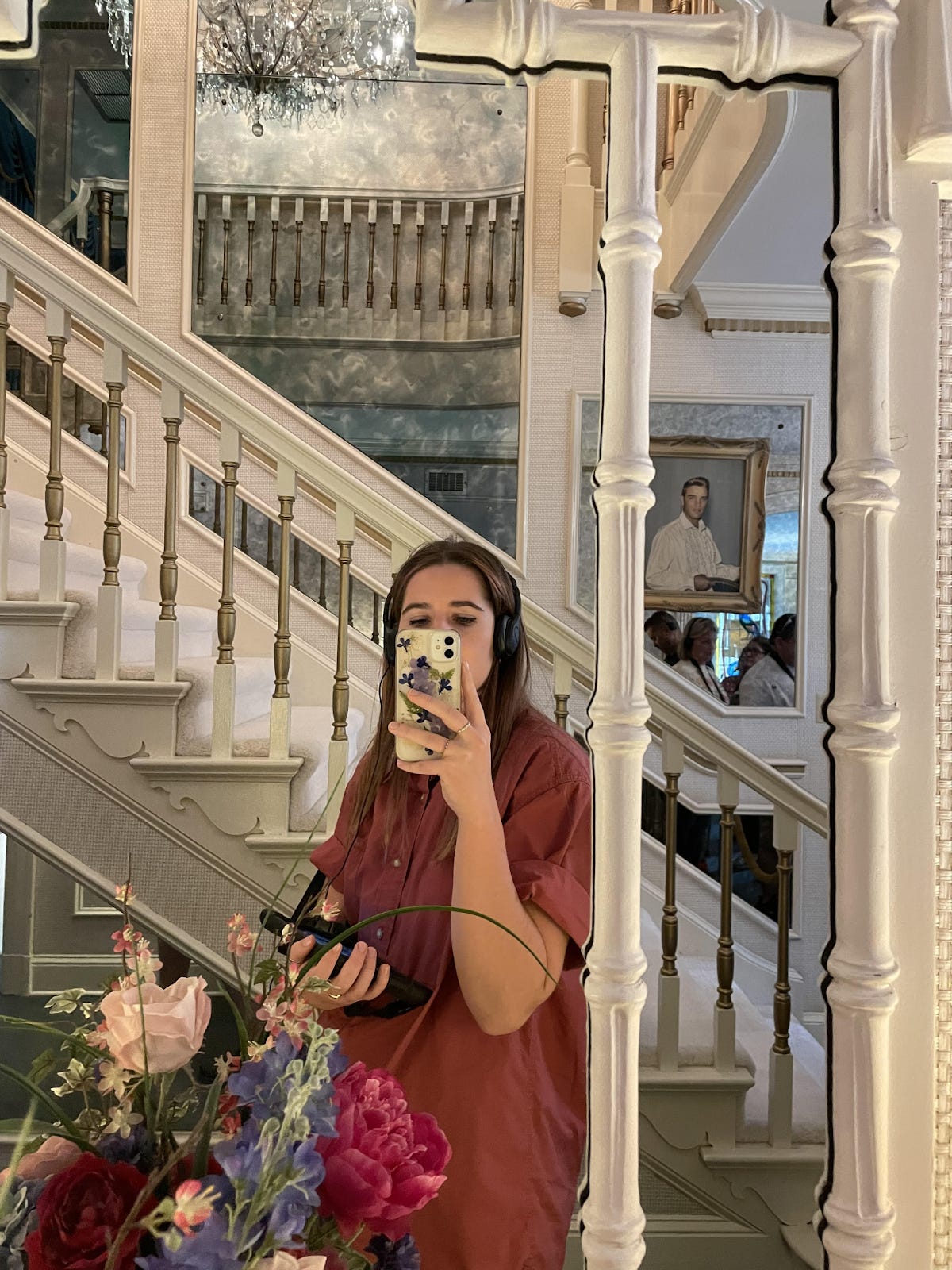
I bought myself tickets to go to Memphis and visit Graceland for my birthday and by the time it was October, I was not doing well and was happy to get away. It was beautiful in October in Tennessee, warm during the day. The light was low and flat, just like the land. Graceland is a cool, strange place. There is a museum complex that feels like an amusement park filled with fans and exhibits full of artists that credit him as inspiration (basically all of American and British rock and pop music). My personal favorite part was the room that had all of his stage outfits in it and, I kid you not, I cried. After you get your fill of paraphernalia, you take this little bus across the street to the house itself. There is a very large custom couch in the front room, portraits of the family, stained glass windows, and mirrors everywhere– I loved the front area. Towards the back, there is the jungle room, a pool room, and a theater that is decorated with this insane 70’s maximalism– some very visually overstimulating spaces.
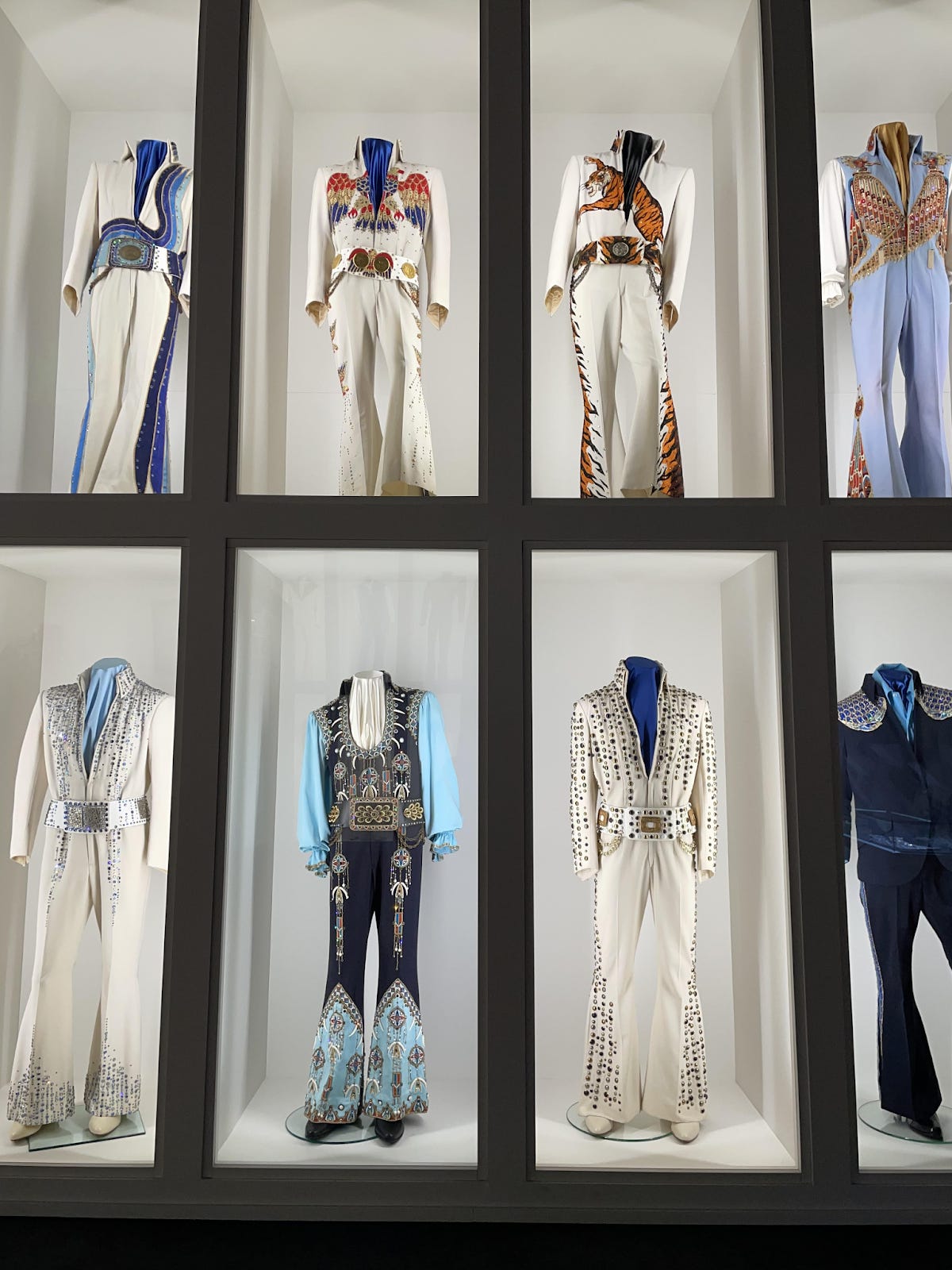
By the time he died, he had spent like 5 years in this sad cycle of touring, doing drugs, and being obsessed with his much younger girlfriends who actively told people they did not care about him. The Coronel was a million dollars in debt and Elvis was running out of money, he was on a lot of prescription drugs and things were not looking good. There is this heartbreaking story at the end of Peter Guralnick’s biography of Elvis about some old friends of Elvis going to see one his last shows and being horrified. They said he looked like he was dying and he was surrounded by all of these people (on his payroll!) who were just helping him along to what seemed to be this inevitable death. In the end, he did die on a toilet in Graceland (drugs mess up your digestion in a big way which is why that was the particular location). The whole discovery of his body sounds horrible. Lisa Marie, aged 6, was there, screaming to know what had happened to her daddy.
At the end of the Graceland walkthrough tour, you get to the cemetery part. Elvis is of course there, as well as his mother, father, and grandmother all in a semi-circle. All of their graves have fake flowers on them; Elvis’s of course has the most, as well as the addition of teddy bears, notes, and flags. After Elvis died, Pricilla wrote her memoir and joined the Church of Scientology with Lisa Marie. They eventually left. After a series of lawsuits against the Coronel, she becomes the sole inheritor of Elvis’s fortune and legacy. Lisa Marie, Elvis’s daughter, married Danny Keough, left him for Michael Jackson, left Jackson for Nic Cage (a marriage that lasted 100 days), and then married Michael Lockwood until their divorce in 2021. In 2008 Lisa Marie had financial troubles because of bad managers and Pricilla ended up having to sell her 8-million-dollar house to bail Lisa Marie out. As you continue along the graveyard at Graceland, there is the exit, or if you turn to the right, one more grave. This one has a massive bouquet of fresh flowers as well as photos in frames. This is the grave of Benjamin Storm Presley Keough, Lisa Marie’s only son. Benjamin looked just like his grandfather and sang well at a very young age. Music companies, excited to get this guy in front of people and singing, gave him this massive record deal that he was unable to fulfill. Ben struggled with substance abuse and depression, things he attributed to the Church of Scientology. Ultimately, he committed suicide in 2020 at the age of 27. Elvis would have been 91 this year. Pricilla is still alive. Lisa Marie died recently, and her two youngest girls are in the middle of a custody battle. Riley Keough is Lisa Marie’s older daughter and an actress.
Memphis is one of the most segregated places in America and one of the most dangerous. Martin Luther King got shot by the FBI (probably) in Memphis. Beale Street is fun for people who like crowds and the blues, but it is not a popular genre despite it being the jumping-off point for most of the popular music today. I went to mostly touristy spots but outside of those, the city seemed dead. No one was on the streets. I had an Uber driver tell me about how guns were readily available, and violence was rampant. He assured me, unsolicited, that he thought that overturning Roe v Wade was a mistake. I got lots of weird looks, alone and white, as I went to recommended restaurants in black neighborhoods. I thought about how white my life was in Utah. On Sunday I went to church and there were only two black people; it was the whitest space of my whole trip.
America is determined to not look itself in the face. We forget our complicated history and then are shocked when it rears its head. We crucify what we are obsessed with. We are too powerful and not powerful enough. Just like my complicated feelings about America, I have complicated feelings towards Elvis and his lore. To me, Elvis is a microcosm of our collective history and our potential collective fate. Pricilla once said that Elvis was the American Dream and I have thought about that a lot because for the first of his story, yes. He came from nowhere and he rose to this unprecedented fame and wealth and status. On the other hand, the back half of his story is a nightmare. Elvis isn’t just the American dream, he is the American reality—he popularized a genre of music created by black artists who were never fairly compensated. He infantilized Pricilla, tried to control her, and wielded total power over her—mirroring our complicated relationship to gender and sex. His massive drug addiction and the way that he covered up all his pain with substances– this is a modern American problem, just look at the opioid epidemic and the pharmaceutical companies who knowingly profited. There is an insatiability about Elvis that is reflected all around us—this desire to stay perpetually stimulated, perpetually entertained. He was so entitled, expecting to get whatever he wanted whenever he wanted, truly believing that he deserved it—sure that is all famous people, but I feel like more and more, Americans have so little patience for anything that requires anything of them. And yet despite all of it, when I watch those early videos of Elvis, smirking at the audience, and flirting with the camera, I am rooting for him. I want this earnest kid from Tupelo, Missouri to make it. And that is how I feel about America too– wouldn’t it be great if we made it?
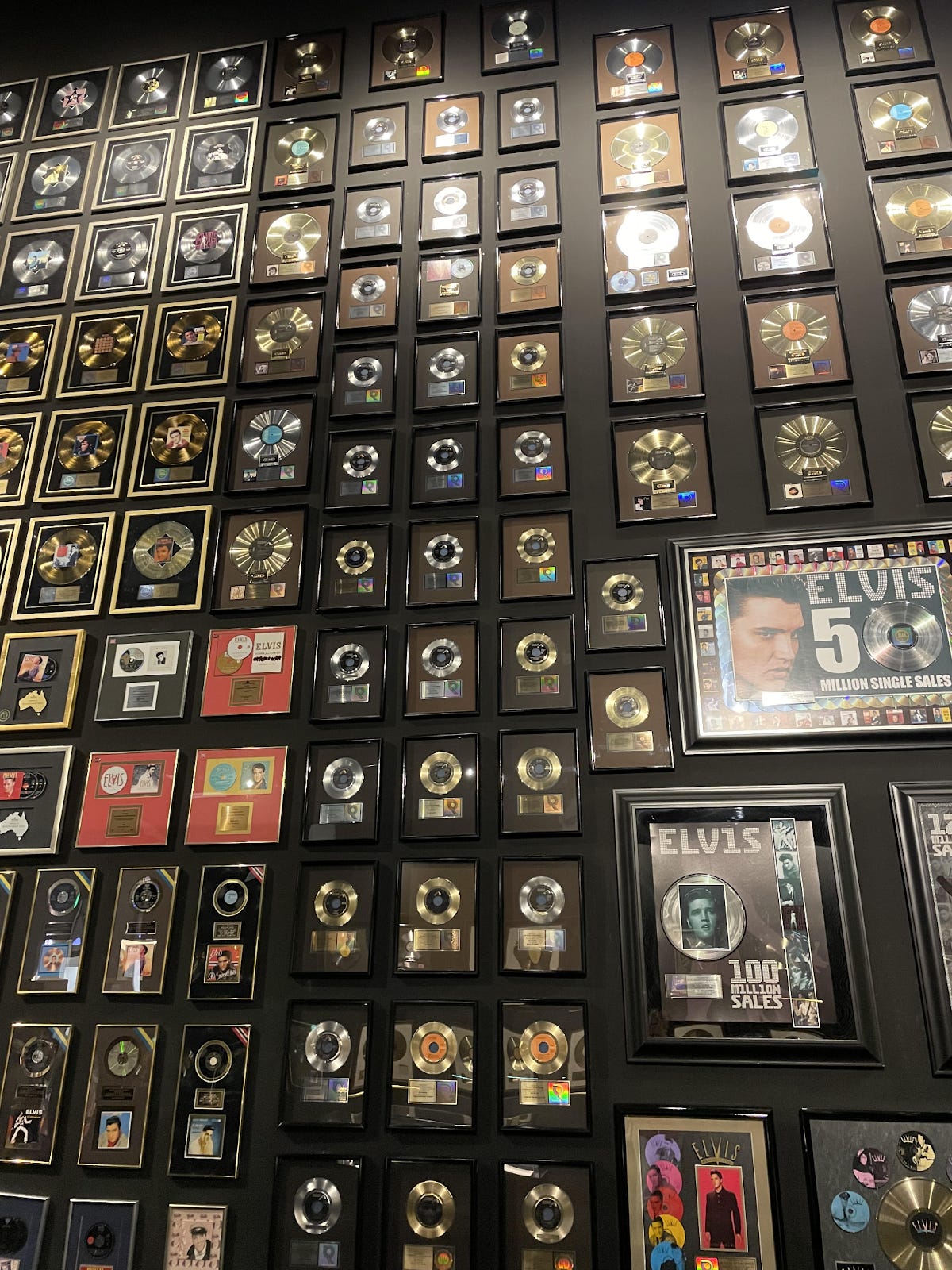
My Elvis Playlist
Heartbreak Hotel, Pocket Full of Rainbows, The Wonder of You, Are You Lonesome Tonight?, Suspicious Minds, Burning Love, Hound Dog, Don’t Be Cruel, Return to Sender, A Little Less Conversation, (You’re the) Devil in Disguise, Unchained Melody, The Girl of My Best Friend, Love Me Tender
1 This is my review: It’s not “good,” but I genuinely feel like no other director could have done a biopic about Elvis because of the GLITTER. Baz movies are not for realism, they are for a *fun time.* Anyway I saw the movie three times in theaters.
2 This is my review: I love Sophia Coppola and I loved the cast and this movie was exactly what I thought it was going to be (complementary): sad white girl in a gilded cage.
3 https://www.vanityfair.com/hollywood/2022/06/elvis-biopic-black-musicians
4 The reason for this is because the Colonel was a merch guy. He just wanted to sell hats and pencils and Elvis was just a great way to do that. Shoot a movie, sell the merch, and cut an album all at the same time? A great deal but creative suicide. I have to say, the movies are pretty much all bad, but they did give me one of my favorite Elvis songs, Pocket Full of Rainbows, so I say, personally, that it’s all fine
 Holly + Scotland
Leave a comment